

The Difference Between Good Intentions and Impact
As Early Childhood Educators, we enter our classrooms with hearts full of good intentions. We want every child to feel safe, valued, respected, and included.
And that matters.
Good intentions are often what bring us to this profession.
But in Diversity, Equity, and Inclusion (DEI) work, there is an important truth we must embrace: Good intentions do not always lead to positive impact.
This does not mean our intentions don't matter. They absolutely do!
The research on implicit bias reminds us that even well-intentioned educators can unknowingly make decisions influenced by unconscious assumptions rather than their conscious values. In other words, we can genuinely care about children and families while still unintentionally causing harm (Safir, 2016; Staats, 2015).
The goal isn't perfection.
The goal is critical reflection.
To truly support the children, families, and communities in our care, we must move beyond simply meaning well and intentionally pair our good intentions with reflection, awareness, presence, and action.
Understanding Unintentional Harm
Most moments of unintentional harm are not rooted in malice. They are often rooted in habit, assumptions, tradition, or simply not knowing what we don't know.
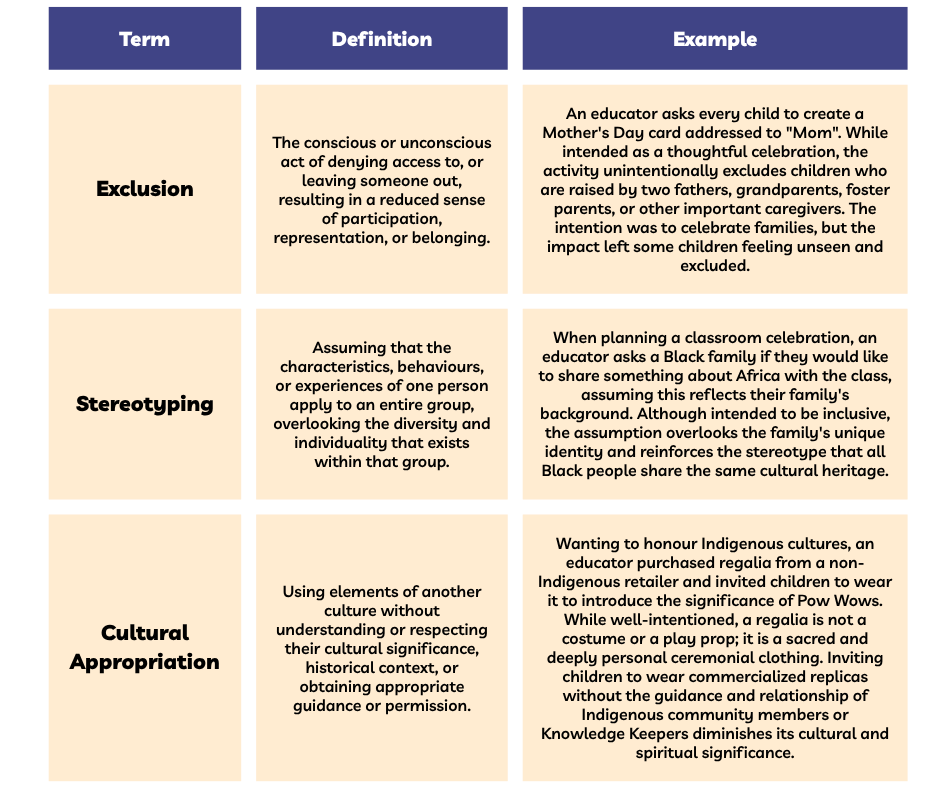
Unintentional harm can show up in many ways. Below are three examples educators may encounter in their everyday practice. The definitions are informed by the
Canadian Centre for Diversity and Inclusion's (CCDI) Glossary of DEIA Terms, an excellent resource for anyone looking to deepen their understanding of inclusive language and practice.
Why Impact Matters More Than Intent
Children don't experience our intentions. They experience the aftermath of our actions.
Every interaction, display, learning invitation, book selection, and family conversation communicates messages about belonging.
Children and families are constantly asking themselves:
- Do I belong here?
- Am I represented?
- Is my language welcome?
- Am I am valued?
Anti-bias education reminds us that belonging isn't created through occasional multicultural activities. It is woven into our relationships, our environments, and the everyday decisions we make (Derman-Sparks & Edwards, 2019).
Whether we realize it or not, our practice shows children who matters and who truly belongs.
Moving Beyond Intent
So, what does this look like in practice? It begins with four simple, yet powerful commitments.
Awareness is recognizing that we all carry unconscious biases shaped by our experiences and intentionally learning about the diverse realities of the children and families we serve.
Reflection is moving beyond defensiveness and asking ourselves What impact did my words or actions have? What assumptions may have influenced my response? What can I do differently next time?
Anti-bias education isn't something we master after attending one workshop or reading one book. It is an ongoing journey of learning, reflection, dialogue, and growth (Derman-Sparks et al., 2015).
Presence is slowing down enough to truly see, listen to, and respond to children and families with curiosity rather than assumption.
Action is where good intentions turn to meaningful impact. It means intentionally applying what we've learned to create environments where every child and family can belong.
When We Get It Wrong
The truth is, we will all get it wrong sometimes.
What matters most is how we respond.
Rather than becoming defensive or explaining our intentions, we can pause, listen, reflect, and repair. Inclusive practice isn't about getting everything right. It's about being willing to learn and ensure that our impact increasingly reflects the care and respect we hope to show every child and family.
Our Impact on the Future
Good intentions are where the journey begins.
Now pair it with reflection, awareness, presence and action and this is how we intentionally create learning environments where every child and family can experience genuine belonging.
The work of an educator is incredibly powerful. Every interaction shapes not only children's learning, but also their sense of identity, belonging, and humanity.
May this article serve not as a reminder of what you're doing wrong, but as a compassionate invitation to continue becoming the thoughtful, reflective educator our children, families, and communities deserve.
Reflection Questions
- What kind of educator do I want to be, and what are the small ways I can intentionally embody that educator in practice every day?
- Where in my practice am I relying on good intentions instead of intentional reflection?
Resources
- Canadian Centre for Diversity and Inclusion's (CCDI) Glossary of DEIA Terms https://ccdi.ca/en/resources-reports
- College of ECE Practice Guideline: Diversity and Culture https://www.college-ece.ca/en/Documents/Practice_Guideline_Diversity_Culture.pdf
- Understanding Anti-Bias Education: Bringing the Four Core Goals to Every Facet of Your Curriculum https://www.naeyc.org/resources/pubs/yc/nov2019/understanding-anti-bias
References
- Derman-Sparks, L., & Edwards, J. O. (2019). Understanding anti-bias education: Bringing the four core goals to every facet of your curriculum. National Association for the Education of Young Children.
- Derman-Sparks, L., LeeKeenan, D., & Nimmo, J. (2015). Building anti-bias early childhood programs: The role of the leader. National Association for the Education of Young Children.
- Safir, S. (2016, March 14). 5 keys to challenging implicit bias. Edutopia.
- Staats, C. (2015). Understanding implicit bias: What educators should know. American Educator, 39(4), 29–33.